



The way we consume news has changed dramatically over the past decade. Audiences expect information instantly, often through social media platforms, podcasts, newsletters, videos and increasingly, AI-powered search engines and tools. At the same time, local news organizations face declining print readership, shrinking advertising revenue and growing competition from countless digital voices, many of which aren’t held to the same journalistic standards.
As misinformation, AI-generated content and opinion increasingly compete for attention, one question has become more important than ever: What does trusted journalism look like in a digital-first world?
The Atlanta Journal-Constitution (AJC) offers an interesting case study. After more than 150 years as Georgia’s newspaper of record, the AJC ended its print edition at the close of 2025 and shifted its focus entirely to digital journalism, from podcasts and videos to newsletters and live events. Its transformation reflects the many challenges—and opportunities—that news organizations across the country are facing.
Behind the Local News Media Scene
Founded as two separate newspapers, The Atlanta Journal in 1868 and The Atlanta Constitution in 1883, the Atlanta Journal-Constitution was purchased by the Cox family in 1950s and merged into one paper in 1982. The AJC was still publishing both a morning and an afternoon edition until it became a morning-only paper in 2001. The final print edition of Atlanta’s newspaper of record was run on December 31, 2025, and the company is now expanding its footprint into digital platforms and live events.
Sports and local politics are the big sellers
After discontinuing their print publication, the AJC downsized and moved its offices from Sandy Springs to midtown Atlanta. The AJC space now includes a newsroom in one building and an adjacent production studio. This space is the home of Dawgnation, a daily podcast about football at the University of Georgia, and Politically Georgia, a daily discussion of local politics.
In designating production space for these two shows, the former newspaper indicates a prioritization of local sports and politics. These topics have invested audience members and few competing voices, so it makes sense that the AJC’s editors identified and filled these gaps.
How Newspapers Are Reinventing Themselves
The news industry overlap between print and digital media is not new, but the transition of a historic print outlet to a completely digital business model showcases how much our entire lives have gone online recently. As many newspapers in the US close in the face of this digital transition — the number of newspapers is down at least 40% in the last 20 years — only a handful have tried to remain relevant in the glut of our contemporary media landscape.
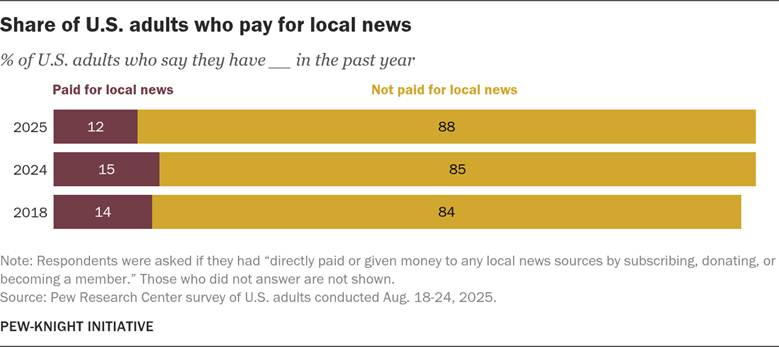
Also, the share of U.S. adults who pay for local news has decreased from 14% in 2018, to 12% in 2025. Without as many readers, the papers lose advertisers, and it starts a vicious cycle. Without advertising dollars coming in to support the publication, these small subscription rates from news consumers cannot support the publication alone. This death spiral continues to claim so many modern newspapers.
With readership going down, the perception of local news’ importance also decreases. Especially in rural communities, there start to be “news deserts” where no one is covering what is going on locally at all.
More trust will help the digital-only AJC, despite the dwindling numbers
The AJC has been kept alive by the Cox family for almost a century. The fact that it is a family-owned outlet is part of why they can choose to stay open, albeit in a completely different form since the cessation of print publication. Now, all the news goes out digitally either through AJC.com, as email newsletters, or through podcasts and YouTube channels. Growing the number of digital subscribers amid all the internet noise relies on audiences retaining trust in the publication in its new form, believing that its reporters continue to practice professional journalism in the way that made the newspaper a stalwart of Atlanta for more than a century.
At the AJC, the shift from a print to a digital-only format has led to an influx of people trained in the broadcast newsrooms of Atlanta’s CNN and elsewhere.
The editor and publisher who oversaw this transition to a digital-only publication was Andrew Morse, who came from a background at CNN and ABC in 2023 and stepped down in June 2026. His goal in the transition to digital distribution was to boost subscriber numbers to 500,000 by 2026. However, the AJC fell short of that total, reaching only 100,000. That’s not surprising considering how few people pay for their local news.
How Digital-First Journalism Finds Its Audience
The AJC described its own transition: “While the AJC will cease print operations, it will continue investing in a suite of digital products aimed at meeting today’s news on-demand consumption habits.”
As justification for the decision to stop printing the physical newspaper, Morse said, “the shift of resources to digital reflects changing audience habits, declining search traffic, and a belief that focusing fully on digital products, subscriptions, video, podcasts, and events is the best way to protect the newsroom and ensure the paper’s long-term survival” (Rough Draft Atlanta article on final AJC print edition, 2025).
Why Trust Matters More Than Ever
As the rise of artificial intelligence hallucinations and intentional disinformation muddy the truth to the point of irrelevance, can a mainstream media organization founded to uncover truth continue to exist?
What society is losing is the professionalization and ethical standards of journalism. Investigative reporting and holding public officials accountable were once the purview of the “fourth estate.” Now, anyone and everyone who holds a phone and posts their opinions to the world on social media can get people’s attention (and usually aim to collect their cash as well.) It’s no wonder our political landscape looks the way it does.
Readers of all age groups increasingly need sources with established editorial standards, transparent reporting, fact-checking and accountability. The question is no longer simply whether newspapers survive, but whether trusted journalism can continue to thrive regardless of the medium.
Credibility Is the Future of Journalism
As the readers/subscribers of a formerly print-only outlet continue to age, and the idea of a newspaper of record for a particular city fades into history, will something arise to hold people in power accountable, giving light to the darkness of intentional obfuscation? As readers, all we can say is, “We hope so.”
In the current chaos of information online, people are right to distrust things they read: baseless opinion, AI hallucinations and straight up lies included. However, the AJC’s long history as a journalistic source putting facts in print can help people trust that what they put online is also true and correct. In one recent discussion about the contentious issue of building out rail on the Atlanta Beltline, a local posting on social media was happy that the AJC chose not to block comments on their article that shared one policymaker’s point of view.
Welcoming the discussion and keeping the conversation going despite its being a controversial topic shows how the AJC can be an open platform in the current media landscape.
Does a mention by the AJC still carry more weight than one by other news sites or outlets? At this point, my answer would be “yes.” The brand recognition in the local Georgia market is still valuable for gaining public trust, even if you won’t see your article in print anymore.
As is often true for public relations, it all depends on the audience you’re trying to reach. With an older demographic especially, for now, the quality of an article you will see from the AJC and the continuing trust in their ethics and journalistic process will give more credence to their content over individual influencers.